Case Analysis
Andrew Tate on Tape: 'We're Scammers' — The Pump-and-Dump Admission, Transcribed
In a video preserved as Exhibit 57 to the First Amended Complaint in Mitchell v. Tate, Andrew Tate says, on camera: 'SEC, come for me. I'm in Romania. There ain't no SEC in Romania. We're scammers, we're [expletive], we're out here doing what we want. I'm gonna pump a coin up, make 10M, peel it off.' Here is what that quote actually is, why the federal RICO complaint treats it as both scienter and modus operandi, and what it means that he said 'we.'
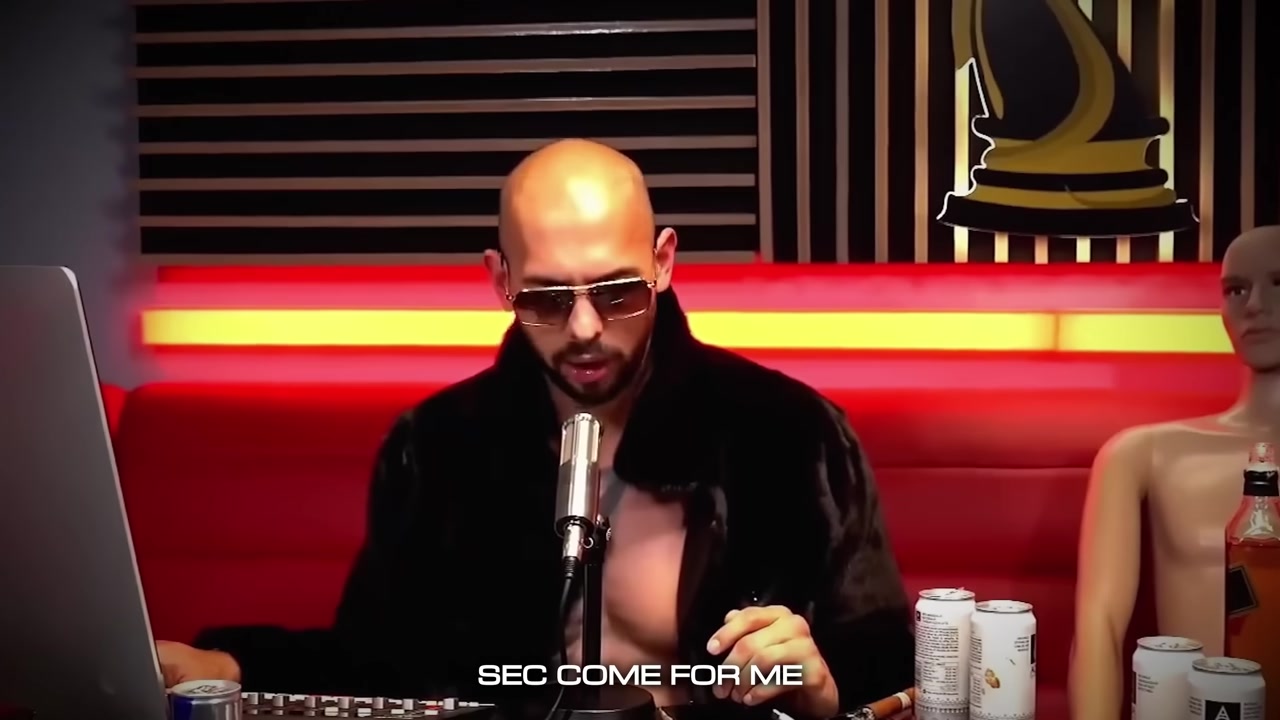
There are dozens of clips of Andrew Tate on the internet. Most of them are bluster. One of them is evidence.
On camera, with a hot microphone and burned-in subtitles confirming the audio, the defendant in Mitchell v. Tate et al. — the federal civil RICO case pending in the District of Nevada — says the following:
"SEC, come for me. I'm in Romania. There ain't no SEC in Romania. We're [expletive] scammers, we're [expletive], we're out here doing what we want. I'm gonna pump a coin up, make 10M, peel it off."
That clip is Exhibit 57 to the First Amended Complaint. The plaintiff pleads it at paragraph 2a as a "first-person, plural-pronoun admission of pump-and-dump methodology coupled with an assertion of immunity from United States securities enforcement," and treats it as the modus operandi alleged throughout the case — direct scienter as to both the cryptocurrency-token scheme and the integrated enterprise. (FAC ¶ 2a; Exhibit 57.)
Watch it in context, then read what it actually says about the case.
Why a single sentence is evidence
In a routine consumer-fraud case, the plaintiff has to prove what the defendant knew. The defendant almost never helps. Intent gets inferred from circumstantial facts — false statements made under conditions where the truth was knowable, patterns of conduct, internal communications that occasionally leak out in discovery.
Tate's quote collapses that whole inferential exercise. He is not deflecting accusations he denies. He is not characterizing what someone else did. He is, in his own words, describing the operating model:
- Pump a coin up — drive the price of a cryptocurrency token through coordinated public promotion.
- Make 10M — realize ten million dollars from the resulting price action.
- Peel it off — exit the position, taking the proceeds.
That is the textbook definition of a pump-and-dump scheme. And he says it immediately after invoking SEC enforcement as something he is immune from. The sequence is the confession: "There is a U.S. agency that polices this. I am not subject to it. I am going to do the thing."
The word "we"
In civil RICO, the threshold question is not whether a defendant did something bad. It is whether a defendant operated or managed an enterprise — an entity, formal or association-in-fact, distinct from himself — through a pattern of racketeering activity. Reves v. Ernst & Young, 507 U.S. 170 (1993).
Tate does not say "I'm a scammer." He says "we're scammers." Twice. In sequence. With a plural verb conjugation that he does not correct, hedge, or walk back.
The FAC's enterprise theory — that Defied Trust Digital Trading – FZCO LLC, New Era Learning LLC, Thrifty Consulting LLC, Thrift Technologies LLC, Andrew Joslin, Issa, and the seven operator-defendants are constituent members of a single association-in-fact enterprise that Tate organizes, manages, and directs (FAC ¶¶ 5, 48) — is not an interpretive leap when the principal himself describes the activity in the first-person plural. The plural pronoun is the enterprise.
This matters because the alternative reading — "Tate was a lone actor and the entities around him are independent" — is the most common Rule 12(b)(6) move available to RICO defendants. Tate's own choice of pronoun makes it a worse argument.
The "I'm in Romania" half
The other half of the sentence is doing legal work too. "SEC, come for me. I'm in Romania. There ain't no SEC in Romania."
That is an explicit declaration that the defendant has structured his physical presence to evade U.S. securities enforcement. It does not, by itself, immunize him from anything — federal civil RICO and the Nevada civil RICO statute do not depend on the SEC; they create private rights of action; and personal jurisdiction in U.S. courts is anchored to acts in or directed at the United States, not the defendant's preferred residence. But it does establish his state of mind about U.S. regulation: he believes geography is his shield.
That belief is wrong on the law. It is also corroborated elsewhere in the docket. The FAC alleges that Tate "moves to a new location on approximately weekly cycles," "uploads photographs and videos of those rented locations and vehicles to his public-facing social-media accounts only after he has departed the rental and moved on to the next location," and "on or around May 15, 2026… departed the United States for Dubai" (FAC ¶ 5). The Romania quote is the policy. The travel pattern is the execution.
For purposes of the Westminster Magistrates' Court forfeiture ruling cited at FAC ¶ 5 — ordering forfeiture of approximately £2.7 million in assets associated with suspected tax fraud and money laundering arising from Tate's online businesses — the Romania positioning is also relevant historical context. A defendant who declares "there ain't no SEC in Romania" on camera is the same defendant whom UK courts have already found to have used jurisdictional positioning to operate businesses under scrutiny.
"I'm gonna pump a coin up" — what coin?
The First Amended Complaint pleads two cryptocurrency tokens at the center of the alleged enterprise's continuity layer:
- $DADDY — Tate's "personal-enterprise" cryptocurrency token, promoted, on information and belief, through coordinated transmissions from multiple Tate-enterprise accounts (FAC ¶ 48(a)(3); Exhibits 58, 59, 60). Tristan Tate's
@TateTheTalismanX/Twitter account is alleged to have posted the $DADDY "introduction" with an embedded Solana blockchain transaction screenshot and a "burn or take the cash and run" public poll on June 13, 2024 (Exhibit 59). - The unauthorized Bangchain token — minted, on information and belief, by defendants or their agents, bearing the name of the plaintiff's hackathon submission, without the plaintiff's authorization (FAC ¶ 48(a)(3); Exhibits 31, 47, 73).
The pump-and-dump methodology Tate describes on camera maps onto both. The FAC quotes him separately admitting that he maintains "an actual infrastructure and ecosystem" supporting his coin operations (predicate (aa); Exhibit 56 at 00:53), and that "Somebody else created DaddyCoin, and then I decided to work with him" (Exhibit 56 at 00:08–12) — the latter corroborating the role of Issa, who the complaint pleads developed $DADDY (¶ 5k(2)).
The 10M figure is also relevant. The FAC pleads injuries including "the loss of the advertised $500,000 Grand Prize and associated prize tiers," approximately 200 hours of skilled AI and robotics development labor, server and hardware expenditures, and unauthorized commercial exploitation of intellectual property (FAC ¶¶ 3, 4). The plaintiff's claimed damages and the order of magnitude Tate himself names in the confession are within the same ballpark.
How it lives in the docket
The full citation in the First Amended Complaint reads:
"Defendant Emory Andrew Tate III publicly admitted the scheme's methodology in his own words. In a clip preserved in third-party investigative reporting, Tate stated, on camera: 'SEC, come for me. I'm in Romania. There ain't no SEC in Romania. We're [expletive] scammers, we're [expletive], we're out here doing what we want. I'm gonna pump a coin up, make 10M, peel it off.' (Exhibit 57; video at https://www.youtube.com/watch?v=e4UJE8XbrUs&t=552s, beginning at timestamp 09:12.) This statement — a first-person, plural-pronoun admission of pump-and-dump methodology coupled with an assertion of immunity from United States securities enforcement — is the modus operandi alleged throughout this Complaint and supplies direct scienter as to the cryptocurrency-token scheme and as to the integrated enterprise."
— FAC ¶ 2a
The clip appears again at FAC ¶ 48(a)(3), in the section pleading the token-issuance and price-manipulation layer of the alleged RICO enterprise. There the complaint frames it alongside Exhibit 56 (the $DADDY-coin YouTube interview transcript) and identifies it as a corroborating element of the "Tate-Issa coordinated-operations relationship from which this token-issuance and price-manipulation layer was operated."
It is also one of the predicate acts indexed in the schedule at FAC ¶ 49 (predicate (aa)) — meaning it is being pleaded not merely as background, but as one of the discrete acts that together make out the "pattern of racketeering activity" required for the RICO claim under 18 U.S.C. § 1962(c).
Other things the same defendant has said on the same record
This is not the only quote in the case. The FAC also pleads:
- "The profits from the school each month will be divided by the token holders" and that purchasing 5% of the contemplated Real World token would entitle the holder to "5% of my school" — FAC ¶ 48(a)(1), citing predicate (aa); Exhibit 56 at 02:46. This is the explicit linkage between the subscription-monetization layer (the $99/month "Conquer" tier) and the token-issuance layer.
- "An actual infrastructure and ecosystem" supporting his coin operations — FAC ¶ 48(a)(3), citing predicate (aa); Exhibit 56 at 00:53.
- Tate's January 30, 2025 X/Twitter direct message to Bryan Mitchell stating that the "Head of hackathon" would reach out — Exhibit 30 — followed by Issa's Telegram message within minutes, opening with "andrew told me to text you" (Exhibit 31). The DM and the immediate Telegram contact together corroborate Tate's operational control of the hackathon's participant outreach.
- Tate's January 30, 2025 public endorsement of Bangchain on X/Twitter, describing it as "perfect for the average crypto trader" — Chronology, FAC; corroborated by Exhibit 25 (the hackathon showcase page displaying Bangchain).
In a defamation case, you would compile a record like this to defeat a claim that the speaker was misrepresented. In a civil RICO case, it serves a different purpose: it removes the inferential ambiguity that defendants normally exploit at the motion-to-dismiss stage.
What this does not do
The Romania quote does not adjudicate the case. It does not establish liability, fix damages, or moot the defendants' procedural rights. The defendants have not yet answered the First Amended Complaint, and every allegation in the FAC — including the characterization of the quote — remains an allegation until tested at the appropriate procedural stage.
What the quote does do is shrink the available rhetorical space for the defense. The two most common responses to a RICO complaint are (1) "I had no idea this was being represented falsely" (innocence as to scienter) and (2) "the entities around me are independent businesses and I do not control them" (no enterprise / no operation-or-management). The plaintiff's submission, anchored in Tate's own video, is that the principal himself has already made both arguments harder.
Read along
- First Amended Complaint (PDF, 664 KB) — read ¶ 2a and ¶ 48(a)(3) in context.
- Exhibits index — searchable, all 78 entries — Exhibit 56 is the $DADDY-coin interview transcript; Exhibit 57 is this clip.
- Andrew Tate RICO Lawsuit Explained — pillar overview — the case in 2,400 words.
- Share your story — if you paid into a Tate platform and want to add to the record.
Tagged
- Andrew Tate SEC
- Andrew Tate scammers video
- Andrew Tate pump and dump
- Andrew Tate Romania
- $DADDY token
- Mitchell v. Tate
- Exhibit 57
- Civil RICO scienter